
.png)
AI-Powered Business Orchestration
AI-Powered Business Orchestration
Digital transformation has long been a priority, aiming to make organizations' operational processes faster, more efficient, and measurable. A common step in this transformation is investing in automation. Many organizations are deploying various automation solutions to reduce manual tasks, digitize repetitive duties, accelerate processes, and keep operational costs under control.
However, it has become evident that in today's business landscape, task-based automation systems alone are insufficient for sustainable efficiency. Corporate processes are now more complex, system architectures are more fragmented, and expectations have become far more dynamic. Many organizations are realizing that their current process automation investments do not deliver sustainable agility or competitive advantage.
In this context, AI-powered business orchestration, stands out as a new standard in operational efficiency. This standard aims to offer a holistic operational model that not only automates specific tasks but also coordinates people, systems, data, and artificial intelligence within the same business processes, providing comprehensive visibility.
Transitioning from Automation to Orchestration for End-to-End Value Creation
Today, many organizations leverage automation technologies to accelerate their operational processes and reduce manual tasks. However, merely automating specific tasks is not always sufficient to achieve end-to-end efficiency. This is because in many organizations, business process automation investments are implemented as fragmented solutions focusing on specific steps, rather than a holistic structure encompassing the entire process.
Therefore, for organizations to achieve true operational efficiency, they must approach automation in conjunction with a business orchestration strategy.
When processes consist solely of automated tasks, operational teams often continue to bear the responsibility for monitoring, control, and intervention. Decision points remain dependent on individuals, scaling processes becomes difficult, and management teams struggle to gain end-to-end visibility. This situation limits the ability of automation investments to generate their expected business value.
In organizations, these shortcomings typically manifest as follows:
Integrations are managed through various systems and tools. Decision-making processes largely rely on manual controls. Instead of being a natural part of the main process, artificial intelligence functions like an independent layer added on afterwards.
Over time, these structures lead to process slowdowns, increased error risks, and operational teams constantly taking on a monitoring and tracking role. Inter-departmental coordination becomes difficult. Even if organizations have achieved automation in certain areas, they struggle to establish a consistent, traceable, and scalable structure across all processes.
At this point, business orchestration emerges as a critical approach that unlocks the true potential of automation. This is because orchestration ensures not only the automatic execution of tasks, but also the management of all actors, systems, decision points, and AI-powered actions within the process, all under a single operational model.
Although process automation is widely used in organizations, it cannot deliver the expected operational efficiency on its own if not supported by business orchestration and modern business management approaches. This is because while automation only speeds up specific tasks, coordination between processes, decision-making mechanisms, and human interactions often continue to be managed manually. To generate end-to-end value, automation must be complemented by a holistic business orchestration approach that coordinates people, enterprise systems, and artificial intelligence within the same process.
The BOAT Approach: The Future of Enterprise Automation
In the business world, automation is no longer considered a standalone technology topic, but rather a part of a broader enterprise transformation approach. Gartner introduced by Business Orchestration and Automation Technologies also known as the BOAT approach, emerges as a result of this need.
The BOAT approach brings together business processes, low-code application development, automation, integration, artificial intelligence, and decision-making mechanisms under one umbrella. This allows organizations to aim for an end-to-end redesign of their operations, rather than just digitizing specific tasks.
This approach offers significant advantages, especially for organizations with multi-system architectures, intensive business processes across different departments, and a desire to rapidly improve operational efficiency.
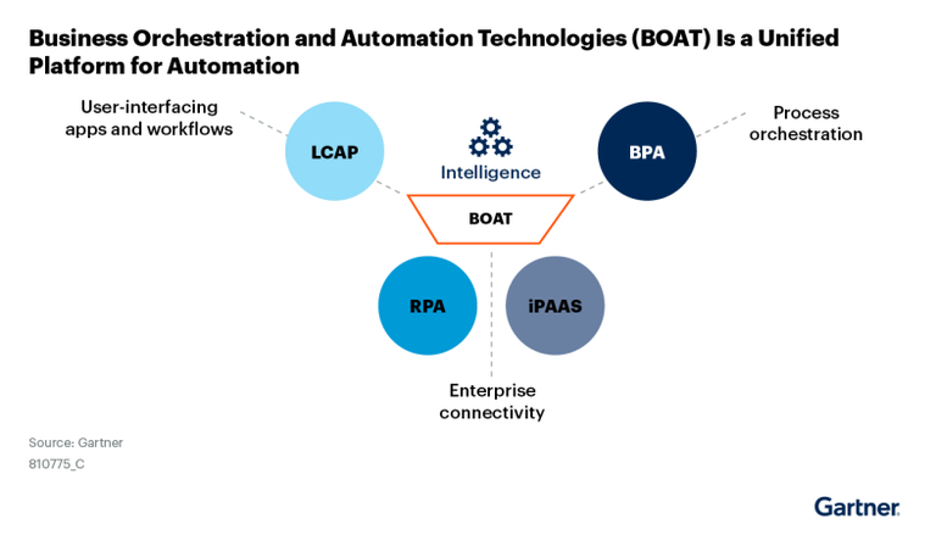
According to Gartner, BOAT platforms; orchestration of business processes, enterprise connectivity, low-code development and agentic automation capabilities to move enterprise automation beyond single-task automation. This approach enables organizations to coordinate people, systems, APIs, workflows, and AI agents within the same operational structure.
Contributions of BOAT Platforms to Enterprise Operations
AI-powered BOAT (Business Orchestration and Automation Technologies) platforms enable organizations not only to automate their processes but also to manage human, system, and AI components under a single operational model. This makes operations faster, more visible, and adaptable to changing business needs.
Key benefits of this approach include:
- Increases enterprise agility
- Provides a seamless and holistic view of business processes.
- Decision points are supported by data and artificial intelligence.
- Increases operational visibility and ensures processes are optimized.
- Strengthens inter-departmental coordination.
These approaches enable organizations not only to meet their current operational needs but also to be prepared for future growth and transformation goals.
AI-Powered Business Orchestration and Automation with FlowAI
AI-Powered Business Orchestration and Automation Platform (BOAT) FlowAI, provides organizations with agility, adaptability, and sustainable growth capacity in today's rapidly changing business dynamics.
With FlowAI:
- Business processes are designed with a LowCode application platform approach.
- Enterprise systems, business processes, employees, and customers are orchestrated through a single platform.
- Human tasks are initiated at the right time with the correct authorizations.
- Support and decision systems work in an integrated manner with processes, alongside the AI-based infrastructure.
- All processes are monitored and optimized end-to-end.
In today's competitive business world, operational efficiency isn't just about automating processes; it starts with orchestrating people, systems, and AI in harmony. FlowAI unifies these components on a single platform.
To see how FlowAI can create value for your business, contact us.